Robots and the Non Aggression Principle

Robots and the Non Agression Principle
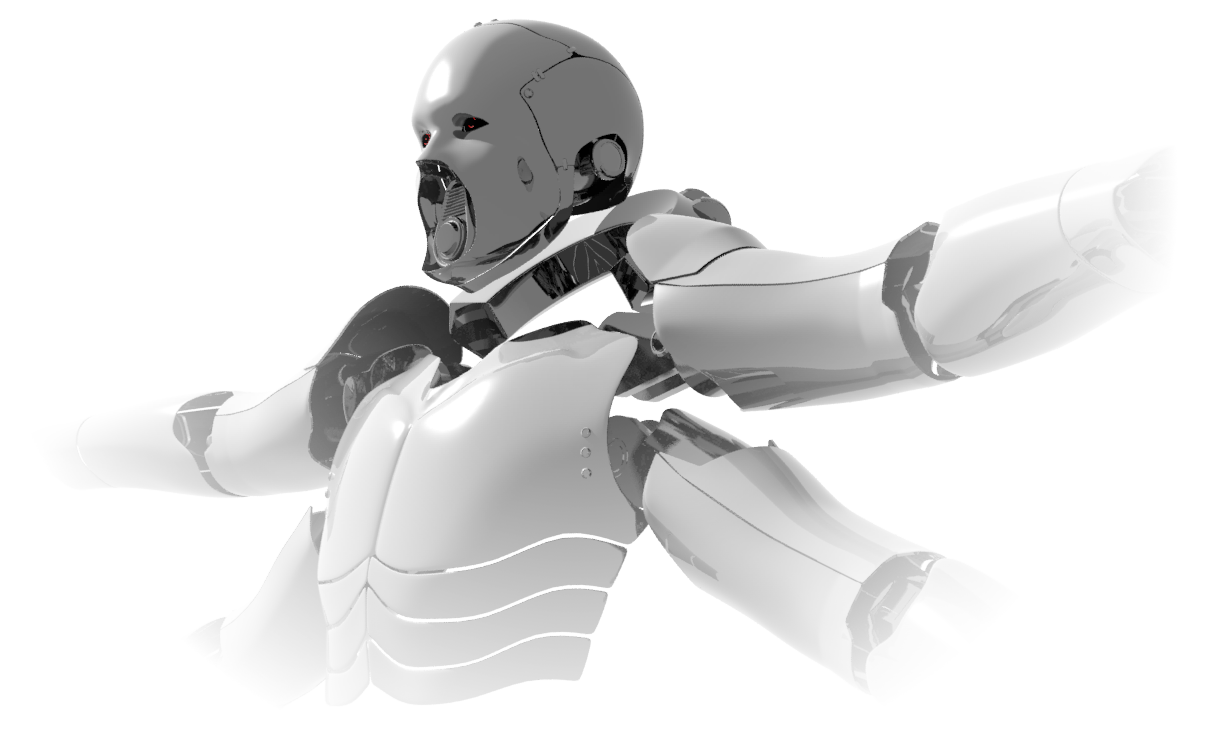
It seems that any science fiction involving sufficiently advanced robots usually includes some element of struggle between them and their human creators.  Is this just a useful plot device, or is their really an inherent danger in creating powerful, rugged, autonomous beings?  Perhaps the behavioral framework within which we have been considering robots is flawed.  Maybe the solution would be treating robots the same way we treat humans (or at least the way we ought to).  Consider the most well-known rules for programming well behaved robots. 

Isaac Asimov defined the Three Laws of Robotics as follows:
  1. A robot may not injure a human being or, through inaction, allow a human being to come to harm.
  2. A robot must obey the orders given to it by human beings, except where such orders would conflict with the First Law.
  3. A robot must protect its own existence as long as such protection does not conflict with the First or Second Laws.
Those seem like pretty good laws, right?  They're pretty airtight.  But, what if we tried something a little bit different?  What if we paused for a moment and decided to program our robots to obey the Non-aggression Principle, the axiom that one shall not initiate the use of force against other persons or their property.  This is a fundamentally different way of treating robots that transcends Asimov's master/slave-relationship-based rules.

I think this is great fodder for any budding libertarian-sympathizing science fiction writers out there.  What would be different? What are the potential pitfalls, and what are the potential benefits of programing robots to be actually autonomous?  Not just autonomous slaves, but nonviolent, nonsubservient, synthetic beings.  Why can't the rules that govern human action also govern the action of artificially intelligent beings? 

Things That Annoy Me - Another Update

I really am going to be a grumpy old man, as evidence by my new label "Things That Annoy Me" required to organize the series of posts devoted to things that annoy me.  Tack on yet another thing that simply drives me insane: 

People who use the term "delta" to mean either "change" or "differential" in spoken language.  

If you are and engineer, or if you work with them, you have probably experienced this.  First of all, the mark of a mature, intelligent person is the ability to communicate at least moderately technical information to the lay person in common language.  Second, unless your audience is made up of engineers, they are not going to understand your meaning.  This is not because it is complex, but because you are simple.  Finally, unless they are as pretentious as you are, they think you sound stupid. 


Beyond Tuition - A New Model for Education

I have a crazy idea - one that I think is just crazy enough to work.  I propose a model for providing education, for a profit, without requiring students to pay tuition.  The model also provides strong incentives for the institution to give career-relevant lessons and to ensure that each student achieves financial success after graduation.  I'm sure I'm not the first person to suggest this, though I have done zero research on the subject. 

The model is simple.  Students are enrolled in the institution based on whatever criteria the school finds appropriate, but the student is never required to pay tuition (room and board, books, etc. are TBD).  The students agree by contract upon enrollment to pay the institution a percentage of their earnings following graduation for an agreed-upon period.  It could be 10 years, or 20 or until retirement.  I'm not sure how the numbers would work out, but it would likely correlate to the reputation of the institution for turning out successful professionals. 

If the school is not successful in fostering a good career for the student, the student owes them little, or nothing.  If there is a widespread failure to provide relevant education (hard to imagine...), the taxpayers are not on the hook to back bad loans paid to students with little chance of making a go of it with their degree in Art History.  The institutions responsible would be...well...responsible. 

First, Assume a Ladder

I was reminded of a joke I haven't heard in a long time but that everyone should keep in mind when listening to economists prattle on about their theories.  I have heard of few variants, but the one from this health care blog was the first to show up in Google and will do just fine:

[Have you heard ]the story of the engineer and the economist who, walking through a remote forest, fell into a very deep hole with vertical sides[?]  The engineer said, "We'll die down here.  No one can hear us calling for help, and it is impossible to climb out."

 The economist said, "On the contrary, there is no problem.  First, assume a ladder."


Peaceful Exploration in the 21st Century

To those who say that exploration cannot be done without the forceful arm of the government, to those who have presumed to take my money by force to see their whims enacted in space and to all those without the vision to see the possibilities of a truly peaceful society, please consider eating crow and donating (voluntarily) to see a small project of great importance get off the ground.  Is it the end of government funded science?  Is it an all-in-one replacement for NASA?  No, of course not.  But it is a beginning.  It is an idea so much more beautiful than two giant, lumbering gangs racing to the moon as to be in an entirely different category. 


Things That Annoy Me - An Update

In an update of my previous post on things that annoy me, I am providing a couple more things that are annoying me as of late:
  1. The overuse of the term "Juxtaposition".  It's not that the term is necessarily used inaccurately, I just see it cropping up all over the place for no particular reason. 
  2. The use of the term "Methodology" when "Method" would be more accurate.  
  3. The use of the term "Phraseology" in almost any case, because "wording" or "phrasing" would almost always suffice and be more accurate. Don't believe me that this actually happens?  Check out this interview with Senator Harry Reid in which he attempts to explain through contorted logic that taxation is voluntary in the United States. 
The common theme today is people trying to sound smart and sophisticated, when their goal really ought to be clarity and accuracy.  This is a common tactic (though rarely is it conscious) among academics and politicians.  My hypothesis is that this results from the lack of incentive for either of these groups to actually be clearly understood.  Both academics and politicians have a considerable amount to gain from the appearance of mental superiority and relatively little to gain from the actual transfer of thought and knowledge. 

The Mothering Effect of Government Regulation

The Case for Regulation

On the surface, government regulation provides a much needed service to our uncertain world and protects us from rampant subjugation to the whims of our neighbors.  It is such a compelling and simple concept that I have a great deal of empathy for those who believe it to be true.  Many of my fellow travelers in the quest for greater individual freedom hold the position that, of course, we need some minimal level of regulation from government.  Who could be so extreme, callous and ignorant to propose that we should have none?

Me for one.

When I was growing up, my mother made us do chores.  I'm glad she did because when I struck out on my own I knew how to cook, sweep the floors, do the laundry and clean the toilet.  I had the skills and the compulsion to keep a clean kitchen and an orderly bedroom.  But when I pause to think about the quality of the work I did as a child and contrast it to that which I do in my own house, I am embarrassed.  Now I was a well-behaved child, but I did the bare minimum I could get by with less I disappoint dear mother.  My style of cleaning in those days could well be described as "hitting the high spots."  I never moved chairs to sweep beneath them.  I rarely took the items off of the bathroom sink to wipe it down.  I mastered the art of pushing them back, wiping and pulling them forward, thus creating an illusion akin to sweeping dust under a rug, which I was also not above.

Comparatively, I am a cleaning Nazi when it comes to my own house - think rigid discipline and rampant germicide. 

Why the disparity?  What drives us to literally and figuratively sweep things under the rug in certain conditions and not others?

Ownership and Responsibility  

The difference now is that I own the house I live in and thus have an internal drive to keep it neat and orderly.  Even when I rented an apartment, the effect of being the sole person responsible for housekeeping created an immediate shift in my behavior.  I knew that if I did not keep my place in order it would directly effect how I felt about myself, and perhaps just as important, how visitors felt about me. 

Granted, in the case of industry in the market there is still the effect of ownership and responsibility to one's customers.   But consider for a moment the effects of a paternalistic regulatory apparatus on the goals of an organization.  The confines of regulation are inherently slow to change and rarely focused entirely on the safety and satisfaction of the consumer or the public at large.  They are necessarily driven in large part by political forces and are usually subject to the powerful influence of relatively small interest groups.  Besides these effects they shift the focus of industry in part away from satisfying customers, which includes an interest in their safety, on to the particular guidelines provided by regulatory bodies.  This provides industry with the perverse objective to dot the i's and cross the t's provided by regulation and then, if they run afoul of public safety, to blame the shortsightedness of the regulatory body which has claimed ownership and responsibility for an orderly society. 
Related Posts Plugin for WordPress, Blogger...