You're familiar with me-firsters right - those people who always want to go first and get the first, best items all for themselves? You probably revile these people and rightfully so. I don't advocate altruism in the sense that one's duty is first to sacrifice for others, but I do recognize that a man leads a better life if he loves and gives. Trampling on others without respect for their wants and needs deserves some reproach. But what I propose to you is that you revile, high above the me-firsters, the we-firsters. These are the apparently kind souls who, upon hearing of something they don't like or broadly disapprove of, claim that "we ought to do something." Whether that something is to invade country x, y or z (or all three), establish a federal schooling system, ban handguns, large capacity magazines and semi-automatic weapons, or pass legislation aimed at keeping drugs off the streets and away from the children, these busy-bodies always want what is best. They just aren't willing to go it alone. They need the help of the royal "we".
Example: "Why don't we do something about Darfur, Afghanistan, and Libya?!"
To me this is like saying, "why don't we do a better job at the Olympics?" "We" isn't the correct word to use. What is meant is "the US Olympic team", just as above is meant the "US Government" or the" US military."
You want to contribute to the success of the Olympic team? Get off your duff and start training. Donate money or volunteer to drive struggling young gymnasts to training at the crack of dawn every day. You want to help the poor or protect the children? How about starting within your self? Champion a cause, donate money to a charity, volunteer your time or peacefully protest that which you see as evil. Stop invoking the long arm of the law to force "us" to help you. See something evil worth stopping? Think "me first!"
Showing posts with label Freedom. Show all posts
Showing posts with label Freedom. Show all posts

More on Mandatory Blood Donation

- If you are a male over the age of 18, you have probably registered for the selective service. As I write this, you are in no danger of being drafted, i.e. forced into slavery and subjected to mortal danger during war time. I cannot speak for the future. From the website of the selective service "In a crisis requiring a draft, men would be called in sequence determined by random lottery number and year of birth." This brings a whole new meaning to the word "service". Sears' call center isn't looking so bad now.
- If you work for a living in sectors of the economy visible to the eyes of the law, somewhere on the order of one-third to one-half of all of your earnings are taken by one government or another. Now of course, you may receive some benefits and services as a result, but nevertheless, your payments are not truly voluntary, contrary to the assertions of Harry Reid.
They don't do it, because the force in the process is too obvious. Evan an idiot like Harry Reid cannot fail to see the needle in the arm, even though he seems oblivious to the gun in the room.
The Not So Fundamental Right to Vote
It's time to elect the "leader of the free world" again. How wonderfully contradictory by the way. Everywhere you look there are proclamations that you need to get out there, exercise your fundamental right and vote. After all, I learned in High School government class that if you don't vote you can't complain about the political system. We cheer when nations around the world hold their first elections - finally liberty and justice for all! We've rallied to war under the battle cry of "making the world safe for democracy." People just have to be able to vote. Anything less would be uncivilized. Our own nation's past with respect to the right to vote is anything but perfect. At one point only property owning white males could vote, but over time we have seen the light and opened it up every adult. Occasionally, there will be an uproar over attempts to restrict voting only to those with identification, and it makes for exciting news stories.
Now I take no umbrage with everyone having the privilege to vote, but I can no longer stomach the cognitive dissonance required to embrace voting as the be-all and end-all of human rights. For instance, while we have been arguing over which individuals should have the opportunity to have zero influence over the make up of government by voting, we have had military conscription. Now to be fair we don't currently have the draft, but there are politicians who salivate at reinstating it in one form or another.
What good is the right to choose your masters without the right to your own life?
Now I take no umbrage with everyone having the privilege to vote, but I can no longer stomach the cognitive dissonance required to embrace voting as the be-all and end-all of human rights. For instance, while we have been arguing over which individuals should have the opportunity to have zero influence over the make up of government by voting, we have had military conscription. Now to be fair we don't currently have the draft, but there are politicians who salivate at reinstating it in one form or another.
What good is the right to choose your masters without the right to your own life?
"You Didn't Build That" - A response in favor of peace
For those of you living under a rock, there has been a recent uproar over something our gentle public servant Obama said the other day. If you search for "you didn't build that", you will doubtless find a great number of news items describing, quoting, misquoting, spinning and backpedaling on the statements of the president. I will not sully my site with the banal news cycle. I simply wish to provide my thoughts on the subject.
There are various arguments of the type, "You couldn't have accomplished (or you wouldn't have possession of) X, Y or Z without the government. The government invested in the internet, microchips, space exploration, your education, and roads. They provided laws and boots for your protection including such things as patents, police, armies, navies and courts. Governments paid Columbus to "discover" the new world and Lewis and Clark to explore and document it. Therefore, you have no cause to complain about taxation or other government interventions which have provided for your general welfare."
These arguments are generally given by the left, though the right is only conditionally allergic to them. They are given in opposition to the simplistic, dare I say Randian, portrayal of the rugged individualist entrepreneur standing alone against the world to profit in a capitalist paradise. They so often end with some variant of, "You didn't accomplish this alone." Well of course is it overly simplistic to think that anyone succeeds in business (or in life for that matter) purely on the merits of their own efforts, but does it follow that we should back off any opposition to government based on this fact?
Of course we all rely on the kindness, savings, investments, intelligence, innovation and business of others in extraordinary and unpredictable ways. You must receive your business inputs, you must obtain the capital and skills to produce your output and your customers must find you and decide to purchase your product at the price you have set. You stand on the shoulders of inventors and discoverers who have come before you and presume that somehow a population will have the wealth and the desire to purchase your wares. You didn't plan all of this; you would have had to start before you were born. So if you succeed in business through loss of your own blood, sweat and tears, whom do owe and how much?
Certainly you can account for the prices paid for your raw materials, your capital equipment, your employees and your education. You will pay interest or give up a portion of future profits to investors. Your parents are unlikely to insist repayment for your upbringing, so you're off the hook there. You either pay rent for your property or you purchased it outright. Last but not least, your customers pay you, which ultimately allows you to pay for all of your inputs. So maybe you owe your customer the most; you clearly couldn't have done it without them. But wait a minute, they received something in this transaction - your product. Did they pay too much? Should you give something back, if not to them then to society? Unless you defrauded them, forced them or sold a defective product, you should not feel the need to repay anyone. The price paid for any good is a reflection of the subjective valuation of that good to the purchaser at the given place and time. You give a man a hamburger, he gives you $5 and you owe each other nothing but mutual thanks. This relationship recurses back through every transaction in the chain of production and we end up with this beautiful, spontaneous, chaotic order in which we can peacefully make progress and profits off the backs of our neighbors and owe them nothing but our thanks.
Now enter a gang of thieves who disrupt this harmonious relationship with force or subterfuge. Their guns represent an attempt to get something from the beautiful order of man without giving anything in return. The gang may in special circumstances provide money in exchange for their takings, but this "price" is meaningless on account of their weapons and their "right" to use them. Imagine a gang large enough to repel all other gangs between the sea and the nearest mountain range. The pragmatic gang will not disrupt the order enough to destroy it as it provides for the welfare of all. They will protect their borders with troops and the order on their streets with police. They will take their cut of commerce flowing in, out and within their realm. The population will become so accustomed to these takings that the guns will be rarely taken out of their holsters for the robbery, which then will be called a tax. If possible they will monopolize the currency used by the populace to aid in extracting the resources required to "maintain" the order, which preceded their existence. Finally, the populace will thank them and sing their praises for false promises written on paper to constrain the power they have already usurped for themselves. They will put roads and build bridges where it pleases them and pay prices that mean nothing for materials and labor. With funds taken from the people, they will pay meaningless fees to scientists to discover things they think people are interested in knowing and engineers to build things they think people will want. In the same way they will enforce a curriculum upon the youth. They will mistake progress with comfort and destroy both by paying men to dig ditches and fill them in. For all of this they will claim a right to thanks from the citizenry. They will shout down objections to their power with claims that the order would not exist without them and that their theft was necessary and beneficial. And at this point, their resemblance to the state is complete.
There are various arguments of the type, "You couldn't have accomplished (or you wouldn't have possession of) X, Y or Z without the government. The government invested in the internet, microchips, space exploration, your education, and roads. They provided laws and boots for your protection including such things as patents, police, armies, navies and courts. Governments paid Columbus to "discover" the new world and Lewis and Clark to explore and document it. Therefore, you have no cause to complain about taxation or other government interventions which have provided for your general welfare."
These arguments are generally given by the left, though the right is only conditionally allergic to them. They are given in opposition to the simplistic, dare I say Randian, portrayal of the rugged individualist entrepreneur standing alone against the world to profit in a capitalist paradise. They so often end with some variant of, "You didn't accomplish this alone." Well of course is it overly simplistic to think that anyone succeeds in business (or in life for that matter) purely on the merits of their own efforts, but does it follow that we should back off any opposition to government based on this fact?
Of course we all rely on the kindness, savings, investments, intelligence, innovation and business of others in extraordinary and unpredictable ways. You must receive your business inputs, you must obtain the capital and skills to produce your output and your customers must find you and decide to purchase your product at the price you have set. You stand on the shoulders of inventors and discoverers who have come before you and presume that somehow a population will have the wealth and the desire to purchase your wares. You didn't plan all of this; you would have had to start before you were born. So if you succeed in business through loss of your own blood, sweat and tears, whom do owe and how much?
Certainly you can account for the prices paid for your raw materials, your capital equipment, your employees and your education. You will pay interest or give up a portion of future profits to investors. Your parents are unlikely to insist repayment for your upbringing, so you're off the hook there. You either pay rent for your property or you purchased it outright. Last but not least, your customers pay you, which ultimately allows you to pay for all of your inputs. So maybe you owe your customer the most; you clearly couldn't have done it without them. But wait a minute, they received something in this transaction - your product. Did they pay too much? Should you give something back, if not to them then to society? Unless you defrauded them, forced them or sold a defective product, you should not feel the need to repay anyone. The price paid for any good is a reflection of the subjective valuation of that good to the purchaser at the given place and time. You give a man a hamburger, he gives you $5 and you owe each other nothing but mutual thanks. This relationship recurses back through every transaction in the chain of production and we end up with this beautiful, spontaneous, chaotic order in which we can peacefully make progress and profits off the backs of our neighbors and owe them nothing but our thanks.
Now enter a gang of thieves who disrupt this harmonious relationship with force or subterfuge. Their guns represent an attempt to get something from the beautiful order of man without giving anything in return. The gang may in special circumstances provide money in exchange for their takings, but this "price" is meaningless on account of their weapons and their "right" to use them. Imagine a gang large enough to repel all other gangs between the sea and the nearest mountain range. The pragmatic gang will not disrupt the order enough to destroy it as it provides for the welfare of all. They will protect their borders with troops and the order on their streets with police. They will take their cut of commerce flowing in, out and within their realm. The population will become so accustomed to these takings that the guns will be rarely taken out of their holsters for the robbery, which then will be called a tax. If possible they will monopolize the currency used by the populace to aid in extracting the resources required to "maintain" the order, which preceded their existence. Finally, the populace will thank them and sing their praises for false promises written on paper to constrain the power they have already usurped for themselves. They will put roads and build bridges where it pleases them and pay prices that mean nothing for materials and labor. With funds taken from the people, they will pay meaningless fees to scientists to discover things they think people are interested in knowing and engineers to build things they think people will want. In the same way they will enforce a curriculum upon the youth. They will mistake progress with comfort and destroy both by paying men to dig ditches and fill them in. For all of this they will claim a right to thanks from the citizenry. They will shout down objections to their power with claims that the order would not exist without them and that their theft was necessary and beneficial. And at this point, their resemblance to the state is complete.
Independence Day
This is the first 4th of July that I would describe myself as an anarcho-capitalist, and I am struggling to pinpoint exactly what it is I should be celebrating and how I should show it. As someone who recognizes the illegitimacy of states in general, it is difficult to muster any nationalistic pride or go along with any of the myriad activities that can only be described as state worship - singing God Bless the USA, taking my hat off for the Anthem, wearing the national colors, honoring a flag, pledging allegiance, thumping my chest for the spreading of "democracy" etc. On the other hand, I have come up with a few things that I can get on board with:
- Blowing things up in a nonviolent way - I like the idea of having a good time demonstrating man's power over nature in a mostly nondestructive and nonaggressive way. I also like the activity of snubbing your nose at states who don't allow certain fireworks (for your own protection of course) by crossing state lines for your purchase.
- Celebrating actual independence - Casting off the yoke of an oppressive regime is always something I can get behind, and some of my ancestors in the American colonies risked their lives to do just that. It doesn't logically follow however that I should stand in reverence to the oppressive regime that has since then taken its place.
- Getting together with loved ones to eat too much and celebrate our "American" culture - It is our personal relationships that fulfill and sustain us, not the promises of the government. Further, it our customs - our food, our languages, dialects and pastimes - that bind us together in peace, not the imaginary lines on the map. It is our societal customs and the good nature of our neighbors and our selves that we rely on to keep us safe and free. To believe that government alone can provide this is a fantasy. To paraphrase the insidious cliche, freedom is indeed not free, but never fall under the misconception that it can be preserved or defended by proxy.
I wish everyone a wonderful day of thoughtful celebration!
Penny4NASA Follow-Up
This thought came to me in the shower, as most good thoughts do, and I thought it was a shame I didn't include it in my previous post:
Consider for a moment the capital expended to mass produce the first automobiles. Now think of how quickly they were adopted, how drastically they changed human activity and productivity and how unbelievably quickly they improved with respect to speed, mobility, style, reliability and efficiency. All of that was produced with hard-earned capital, voluntarily given in expectation of profit, and a healthy dose of enterprising individuals employed for the same cause. Now compare this with NASA's history. The expenditure has been enormous, not to mention it was all taken by force, and the payoff relatively small. The so-called "spin-off" technologies and secondary externalities created by the agency seem paltry compared to the advances in technology Ford alone developed. I encourage anyone to look them up. While you're at it, read Garet Garett's The Wild Wheel.
Freedom, Peace and Liberty - 1
Tyranny, Force and Plunder - 0
Related Posts:
Pennies for Flying Cars - Another Tale of the Unseen
Pennies for NASA - Ignoring Cost at all Cost
Consider for a moment the capital expended to mass produce the first automobiles. Now think of how quickly they were adopted, how drastically they changed human activity and productivity and how unbelievably quickly they improved with respect to speed, mobility, style, reliability and efficiency. All of that was produced with hard-earned capital, voluntarily given in expectation of profit, and a healthy dose of enterprising individuals employed for the same cause. Now compare this with NASA's history. The expenditure has been enormous, not to mention it was all taken by force, and the payoff relatively small. The so-called "spin-off" technologies and secondary externalities created by the agency seem paltry compared to the advances in technology Ford alone developed. I encourage anyone to look them up. While you're at it, read Garet Garett's The Wild Wheel.
Freedom, Peace and Liberty - 1
Tyranny, Force and Plunder - 0
Related Posts:
Pennies for Flying Cars - Another Tale of the Unseen
Pennies for NASA - Ignoring Cost at all Cost
Pennies for Flying Cars - Another Tale of the Unseen
Wouldn't it be great if I drove a flying Mercedes-Benz? I certainly think so! Wouldn't it be great if everyone else did too? No doubt. Of course we would need to nationalize a major car company, but I don't anticipate any obstacles there.
How much would you pay for the universe (of flying cars)? How do we examine the costs and benefits?
Besides the mere fact that everyone would be flying in style with little concern for congestion, just think of all the stimulative effects it would have on society. We would probably all save a bunch of time going to and from work. The ability to fly would eliminate many of the complexities associated with driving and would probably facilitate automating the process. This would free us from the drudgery of the daily commute and essentially make the world smaller, expanding our zone of employment and improving our earning power. Besides all that, I certainly would feel better about myself and my status, being a hot-rod pilot and all. I would probably start dressing better, and maybe I would have the esteem to go for that big promotion at work. Multiply that by millions of people so effected and imagine the economy purring along like a spoiled kitten. Children everywhere would be inspired by the wonder of daily flight, as well as the precise engineering, the smooth handling and the attractive contouring that go along with the now ubiquitous, flying Mercedes-Benz. Just imagine the young crop of overachieving engineers, scientists, designers and artists growing up and really getting after it in an ever expanding world of opportunity! Beyond all of that, we're bound to happen upon a great many wealth-producing discoveries and labor-saving inventions in our quest to mass produce flying cars. We can't afford to let go of this dream! People probably won't go for it voluntarily, so we'll probably need the government to foot the bill.
Foolish, childish ideas and hyperbolic extrapolations? Absolutely. No one would ever seriously propose such an expensive, narrow-minded, centrally-planned "national greatness" program simply on the grounds that it would be inspirational or generally stimulative. First of all, to attribute the life decisions and successes of any individual in an advanced society (let alone that of a group of such individuals) to a single program, stimulus or event is utter foolishness. Further, to claim that directing that desire toward a particular field in lieu of all others is an improvement on the situation of men is a fatal conceit indeed. Inspiring a young Sam Walton to design thrusters for the new F-Class would have deprived us of Walmart, which would have been an injustice nearly beyond this author's will to consider.
The rationalization of the program based on the stimulative effects of inventions made in the process is a particularly special pleading based on ignoring the costs of the program itself. Of course the monetary price we would pay for the program is obvious, but the activities forgone in order to support it will forever be hidden to us. I am not speaking here of what other great national work must be given up, like the Federal Jetpack Program, though that is a viable concern. I am considering what activities in the private (or peaceful) market place must be displaced in order to make the flying car dream a reality. It takes real saved wealth to pull off a project like this, and since the government has none, they'll have to take it away from someone (more likely a whole bunch of someones). Your guess is as bad as mine as to what that saved wealth would have been used for. Some of it no doubt would have been saved for consumption at a later date, while some of it would have been consumed right away on things like candy, shirts, smart phones and regular, old-fashioned rolling cars. So that's simple enough; we're just asking for little Johnny to go without his chocolate for the week, or little Susan to cut back on the texts or 16 year-old Franklin's parents to go for the fixer upper instead of certified pre-owned. That's not so much to ask of the patriotic citizen for the common dream of flying cars. If you buy that argument, I guess this is where we go our separate ways, but there is one last thing I would like you to consider - investment. Some of that wealth would have been invested in a broad array of forward-looking ventures, most of which probably would have had a better chance of turning a profit than the lofty dream of flying luxury cars. Some, no doubt, would have been massive failures that were either poorly managed or not well thought out or both, but if history is any guide, a great many of them would have been successful, some of them fantastically so. There would have been some AOL-TimeWarner's and some Betamax's, but there would also be the Amazon's and the Apple's. Maybe we would be missing out on the next Iphone, Ipad, or hell, the Icar (not flying til generation 4.f). Maybe Bayer would have cancelled a line or research on some young drug that would have turned out to cure cancer, or AIDS, or diabetes. Maybe Pfizer pulled back on the next great erection enhancer. Maybe Kenmore's new dishwasher would have saved us more time at less expense than the flying 'Benz. The fact is, we'll never know the costs of the great flying machine project because they are simply immeasurable. So you tell me if you can justify taking your neighbor's wealth by force to support this or any other technological fantasy.
In my previous post on the subject of Penny4NASA, I focused on the fiscal irresponsibility of clamoring for increased NASA funding. Now I hope I have demonstrated the fallacious nature of the arguments used to present the supposed benefits of increased funding for the program as expounded on said website:
I hope my work can be a massively huge inspiration bringer to young thinkers everywhere so that they can root out the legal plunder of the future, today.
Related Posts:
Pennies for NASA - Ignoring Cost at all Cost
How much would you pay for the universe (of flying cars)? How do we examine the costs and benefits?
Besides the mere fact that everyone would be flying in style with little concern for congestion, just think of all the stimulative effects it would have on society. We would probably all save a bunch of time going to and from work. The ability to fly would eliminate many of the complexities associated with driving and would probably facilitate automating the process. This would free us from the drudgery of the daily commute and essentially make the world smaller, expanding our zone of employment and improving our earning power. Besides all that, I certainly would feel better about myself and my status, being a hot-rod pilot and all. I would probably start dressing better, and maybe I would have the esteem to go for that big promotion at work. Multiply that by millions of people so effected and imagine the economy purring along like a spoiled kitten. Children everywhere would be inspired by the wonder of daily flight, as well as the precise engineering, the smooth handling and the attractive contouring that go along with the now ubiquitous, flying Mercedes-Benz. Just imagine the young crop of overachieving engineers, scientists, designers and artists growing up and really getting after it in an ever expanding world of opportunity! Beyond all of that, we're bound to happen upon a great many wealth-producing discoveries and labor-saving inventions in our quest to mass produce flying cars. We can't afford to let go of this dream! People probably won't go for it voluntarily, so we'll probably need the government to foot the bill.
Foolish, childish ideas and hyperbolic extrapolations? Absolutely. No one would ever seriously propose such an expensive, narrow-minded, centrally-planned "national greatness" program simply on the grounds that it would be inspirational or generally stimulative. First of all, to attribute the life decisions and successes of any individual in an advanced society (let alone that of a group of such individuals) to a single program, stimulus or event is utter foolishness. Further, to claim that directing that desire toward a particular field in lieu of all others is an improvement on the situation of men is a fatal conceit indeed. Inspiring a young Sam Walton to design thrusters for the new F-Class would have deprived us of Walmart, which would have been an injustice nearly beyond this author's will to consider.
The rationalization of the program based on the stimulative effects of inventions made in the process is a particularly special pleading based on ignoring the costs of the program itself. Of course the monetary price we would pay for the program is obvious, but the activities forgone in order to support it will forever be hidden to us. I am not speaking here of what other great national work must be given up, like the Federal Jetpack Program, though that is a viable concern. I am considering what activities in the private (or peaceful) market place must be displaced in order to make the flying car dream a reality. It takes real saved wealth to pull off a project like this, and since the government has none, they'll have to take it away from someone (more likely a whole bunch of someones). Your guess is as bad as mine as to what that saved wealth would have been used for. Some of it no doubt would have been saved for consumption at a later date, while some of it would have been consumed right away on things like candy, shirts, smart phones and regular, old-fashioned rolling cars. So that's simple enough; we're just asking for little Johnny to go without his chocolate for the week, or little Susan to cut back on the texts or 16 year-old Franklin's parents to go for the fixer upper instead of certified pre-owned. That's not so much to ask of the patriotic citizen for the common dream of flying cars. If you buy that argument, I guess this is where we go our separate ways, but there is one last thing I would like you to consider - investment. Some of that wealth would have been invested in a broad array of forward-looking ventures, most of which probably would have had a better chance of turning a profit than the lofty dream of flying luxury cars. Some, no doubt, would have been massive failures that were either poorly managed or not well thought out or both, but if history is any guide, a great many of them would have been successful, some of them fantastically so. There would have been some AOL-TimeWarner's and some Betamax's, but there would also be the Amazon's and the Apple's. Maybe we would be missing out on the next Iphone, Ipad, or hell, the Icar (not flying til generation 4.f). Maybe Bayer would have cancelled a line or research on some young drug that would have turned out to cure cancer, or AIDS, or diabetes. Maybe Pfizer pulled back on the next great erection enhancer. Maybe Kenmore's new dishwasher would have saved us more time at less expense than the flying 'Benz. The fact is, we'll never know the costs of the great flying machine project because they are simply immeasurable. So you tell me if you can justify taking your neighbor's wealth by force to support this or any other technological fantasy.
In my previous post on the subject of Penny4NASA, I focused on the fiscal irresponsibility of clamoring for increased NASA funding. Now I hope I have demonstrated the fallacious nature of the arguments used to present the supposed benefits of increased funding for the program as expounded on said website:
NASA contributes to society in massively huge ways in terms of technological, economical, and inspirational progress. The progress that we have seen in the last 40 years comes largely from the world's extremely talented scientists and engineers. Now, talk to most any scientist and/or engineer of the last 40 years, and we are willing to bet that they were drawn into their chosen field by something NASA related. And more often then not, they refer to the Apollo, Gemini and/or Space Shuttle program where humans were physically advancing a frontier. It's the human spirit of exploration that drives the world's greatest technologists to invent the future, today. We want to see to it that the US annual budget allocation for NASA reflects that hugely important role technology, economy, and inspiration bringer.
I hope my work can be a massively huge inspiration bringer to young thinkers everywhere so that they can root out the legal plunder of the future, today.
Related Posts:
Pennies for NASA - Ignoring Cost at all Cost
In Defense of Moonshiners
You might say that I come from a long line of men who enjoy the drink, so if anyone were to be helped by the paternalistic ban on booze, it would be me. Unfortunately, it is incongruent with human nature to think that anyone can be protected from themselves.
It's been rumored that my grandfather made moonshine. He was coal miner in southern West Virginia, so as far as I can tell, the story checks out. Regardless, let's take a moment to think about who might be hurt from his alleged business.
First, let's consider the case in which he makes a good and safe product. The most obvious victim is the consumer who cannot control his actions under the influence of alcohol let alone curtail his own consumption of it. Everyone is familiar with the story of the drunk who, during the brief period during which he keeps his job, goes home and beats his family after a long day at the mill. Doubtless he and his family would be better off without access to alcohol. So fine, let's make a law banning the production, distribution and consumption of alcoholic beverages. Wait a minute, didn't we try that? What happened? People kept drinking spirits, which were purchased on a black market. Black market purchases, as always, were accompanied by violence and products of inferior and practically unverifiable quality. So the drunk either, in the best case, went blind from drinking methanol, got caught up in gang violence and was killed or, in the worst case, continued to beat his wife and kids. An organized and ruthless system of crime developed around this black market, leading to a loss of safety and security for the masses, the dissolution of the seemingly well-intended law, and providing fodder for the greatest films of the 20th century. So much for protecting the first class of victim of this otherwise safe and reputable product. It turns out there were a great number of unforeseen victims ignored by the well-meaning legislators, as is usually the case.
Second, you may say, "There is no guarantee that his product is safe and reliable. He could really hurt some people by selling wood alcohol or blowing up his home and still." Fine, let's regulate the production and distribution of alcoholic beverages. This should sound perfectly reasonable and familiar to everyone. But to whom do we grant these licenses and for what cost? How do we separate ourselves from the organized crime bosses, who after all merely sought to bring order to the unruly anarchy before them and who employ the same tactic that we propose - physical force? You may say that we elect officials to conduct our raids and protect our made men at our chosen distilleries, but this is merely different in magnitude, not in kind. Had Capone's business been more popular in the eye's of the public, would any among us have considered them just? Those of us who wish to govern must understand that proclaiming the power to license inexorably weakens our armor to corruption as those who have purchased our favor will certainly pay to keep their neighbors out. So, by assuming rights we do not have, we will have disrupted what integrity remains of our government all in the name of an alleged good which can never be measured at cost which can never be known.
Let the moonshiner's reputation govern the safety and quality of his product. Let him engage in peaceful transaction with his benefactors in the sanitizing light of day. Let freedom ring; and let's have another drink!
It's been rumored that my grandfather made moonshine. He was coal miner in southern West Virginia, so as far as I can tell, the story checks out. Regardless, let's take a moment to think about who might be hurt from his alleged business.
First, let's consider the case in which he makes a good and safe product. The most obvious victim is the consumer who cannot control his actions under the influence of alcohol let alone curtail his own consumption of it. Everyone is familiar with the story of the drunk who, during the brief period during which he keeps his job, goes home and beats his family after a long day at the mill. Doubtless he and his family would be better off without access to alcohol. So fine, let's make a law banning the production, distribution and consumption of alcoholic beverages. Wait a minute, didn't we try that? What happened? People kept drinking spirits, which were purchased on a black market. Black market purchases, as always, were accompanied by violence and products of inferior and practically unverifiable quality. So the drunk either, in the best case, went blind from drinking methanol, got caught up in gang violence and was killed or, in the worst case, continued to beat his wife and kids. An organized and ruthless system of crime developed around this black market, leading to a loss of safety and security for the masses, the dissolution of the seemingly well-intended law, and providing fodder for the greatest films of the 20th century. So much for protecting the first class of victim of this otherwise safe and reputable product. It turns out there were a great number of unforeseen victims ignored by the well-meaning legislators, as is usually the case.
Second, you may say, "There is no guarantee that his product is safe and reliable. He could really hurt some people by selling wood alcohol or blowing up his home and still." Fine, let's regulate the production and distribution of alcoholic beverages. This should sound perfectly reasonable and familiar to everyone. But to whom do we grant these licenses and for what cost? How do we separate ourselves from the organized crime bosses, who after all merely sought to bring order to the unruly anarchy before them and who employ the same tactic that we propose - physical force? You may say that we elect officials to conduct our raids and protect our made men at our chosen distilleries, but this is merely different in magnitude, not in kind. Had Capone's business been more popular in the eye's of the public, would any among us have considered them just? Those of us who wish to govern must understand that proclaiming the power to license inexorably weakens our armor to corruption as those who have purchased our favor will certainly pay to keep their neighbors out. So, by assuming rights we do not have, we will have disrupted what integrity remains of our government all in the name of an alleged good which can never be measured at cost which can never be known.
Let the moonshiner's reputation govern the safety and quality of his product. Let him engage in peaceful transaction with his benefactors in the sanitizing light of day. Let freedom ring; and let's have another drink!
A whore should be judged by the same criteria as other professionals offering services for pay—such as dentists, lawyers, hairdressers, physicians, plumbers, etc. Is she professionally competent? Does she give good measure? Is she honest with her clients? It is possible that the percentage of honest and competent whores is higher than that of plumbers and much higher than that of lawyers. And enormously higher than that of professors. -- Robert Heinlein, Time Enough for Love
Incandescent Bulbs - The Seen and the Unseen
During a large portion of the year, in a large portion of the world, I would argue that the incandescent bulb is 100% efficient. Provocative enough? Well it shouldn't be. If you're thinking that incandescent bulbs are generally reported to be 10-20% efficient, you are correct. But the energy that is wasted is simply heat put off by the bulb. Here in Pittsburgh there are only 4-5 months out of the year that I am not running the heat, at least intermittently. This means the heat put off by the bulb, even though it is quite small in magnitude, is helping me heat my house. So from my perspective, the bulb is 100% efficient during such time. I doubt this consideration has been included in the justification of the laws attempting to ban incandescent bulbs in favor of the "more efficient" compact florescents. This thinking is in line with the overly constrained and simplified engineering perspective that our great leaders so often take when attempting to run out lives. They will always fail to take into consideration all potential use cases - in this case they missed a pretty big one. It is relatively easy to come up with models and estimates for how much product X is going to save the average consumer Y. The difficulty comes in extrapolating those savings to the entire population. It is quite easy to imagine scenarios in which a CFL does not save John Q. Citizen any money or is more trouble than it is worth. But it doesn't matter. Our choice will be forcibly constrained so that model citizen Y may save a few bucks using his light bulbs in a particular way.
University Pelf
I went to my home state's flagship university for my undergraduate engineering degree. I had a classmate there who thought he was particularly bright. Most of us begged to differ, and he didn't have the most endearing personality. He once laughed at me in 2006 for suggesting that Microsoft would loose market share to its competitors and that the specter of its "monopoly" would run its own course if left alone. He struck me as particularly lazy, both intellectually and physically, and he was a poor leader of our senior design team despite his campaign to the contrary. I was delighted to learn this morning in our alumni magazine that he is now a professor at the university and the new poster child of a considerable DOD grant to develop the next super weapon for the never ending War on Everyone. I couldn't think of a more appropriate person to represent the suckling piglets of university pelf.
pelf - money or wealth, especially when regarded with contempt or acquired by reprehensible means.
It has become an archaic term, but I suggest we bring it back.
pelf - money or wealth, especially when regarded with contempt or acquired by reprehensible means.
It has become an archaic term, but I suggest we bring it back.
I Am Officially Getting in the Way
It's easy to miss the point of an article, blog or oral argument, especially when you are more interesting in grinding your ax than really understanding the other point of view. It turns out this is even the case for highly skilled philosophy experts.
Every struggling upstart blogger is thrilled to see notifications of comments on one of their posts. I am no different; I relish each of the 10 comments my site has received. A few weeks ago I was delighted to see a new comment but was surprised to find that it was a tag from another blog. I pasted the address into my browser and was delighted to find a rather lengthy article devoted to missing the point of my original commentary which was essentially a very simplified, sound-bite-style summary of the socialist calculation problem. I never intended for the piece to be a thorough dissertation on the topic, but rather, a rant the blow off steam and preach to for four-person choir that is my following. But I posted it nonetheless, so it is fair grounds for debate. It is a curious strategy to pick on a blog nobody reads, but I am flattered still.
The argument, which was about 5 times the length of my original post, went something like this (parenthetical statements are to be taken from my perspective):
Really, "we" know how to make it better?! Then why didn't "we" stop it from happening in the first place. The author must suffer from the delusion that there was no central planning going on prior to the crash and that only the government can swoop in and save us from the dastardly deeds of "the market". The original point he is missing, and I take part of the blame for being so terse to begin with, is not that no one is smart enough, talented enough or even skilled enough to manage an economy. The point is that no one will ever acquire the knowledge needed to do such a thing at the time they will have needed to do it. To think otherwise is pure hubris, and frankly, quite dangerous. This is not pessimism per se; I simply disagree with the position. that "we" can and must do something. I am quite optimistic that free individuals left to their own devices and allowed to live, innovate, and trade freely will prosper.
Besides all of the practical considerations, which I leave to Mises, Hayek and Rothbard for further detail, there is no moral justification for central planning. No amount of skill gives anyone the right to force me to use a particular type of money or to spend it on a particular type of good. No level of crisis gives anyone the right to take something from one individual by force and give it to another. It seems pretty clear to me, that the man who proposes we give up on peace and start imposing the will of the state on formerly free people should bear an enormous burden of proof well beyond torturing a distinction between "talent" and "skill". Further, it is clear that he is the one standing between us an prosperity.
The author, after missing the finer points, has hit square upon the central purpose of this blog - to get the fuck in the way...
...of legal plunder*.
*If you didn't get this, you haven't been reading enough Bastiat.
Every struggling upstart blogger is thrilled to see notifications of comments on one of their posts. I am no different; I relish each of the 10 comments my site has received. A few weeks ago I was delighted to see a new comment but was surprised to find that it was a tag from another blog. I pasted the address into my browser and was delighted to find a rather lengthy article devoted to missing the point of my original commentary which was essentially a very simplified, sound-bite-style summary of the socialist calculation problem. I never intended for the piece to be a thorough dissertation on the topic, but rather, a rant the blow off steam and preach to for four-person choir that is my following. But I posted it nonetheless, so it is fair grounds for debate. It is a curious strategy to pick on a blog nobody reads, but I am flattered still.
The argument, which was about 5 times the length of my original post, went something like this (parenthetical statements are to be taken from my perspective):
- Talented individuals do not always perform up to their expectations.
- Sometimes less talented individuals outperform more talented ones by better honing their skills and being more well rounded.
- Therefore skill is the relevant metric for predicting success as opposed to talent.
- The quoted statement (from my post) implies that no one will ever be talented enough to effectively centrally plan an economy (a gross misunderstanding). We already know how irrelevant talent is, therefore this statement is false.
- Our institutions have it all wrong because they tend to look at talent instead of skill.
- Parents who tell their children to follow their talents and do what they love are "almost criminal" because alot of people don't like their jobs.
- Therefore, we can't give up on central planning because we haven't been appropriately looking for or demonstrating the skills required to be successful at it. We have to keep our optimism and keep plugging away (in spite of a total lack of evidence to the efficacy of central planning).
"This is just one more reason why I find libertarian bomb-throwing to be wearying: we already know that something is going wrong, and we already know how to make it better. What we need is for fewer people to pounce on the opportunity to be bitterly pessimistic and instead look around them at the ways in which we can, have, and do make things work - or, in the case of people who can't manage that, to at least have the courtesy to stay the fuck out of the way."
Really, "we" know how to make it better?! Then why didn't "we" stop it from happening in the first place. The author must suffer from the delusion that there was no central planning going on prior to the crash and that only the government can swoop in and save us from the dastardly deeds of "the market". The original point he is missing, and I take part of the blame for being so terse to begin with, is not that no one is smart enough, talented enough or even skilled enough to manage an economy. The point is that no one will ever acquire the knowledge needed to do such a thing at the time they will have needed to do it. To think otherwise is pure hubris, and frankly, quite dangerous. This is not pessimism per se; I simply disagree with the position. that "we" can and must do something. I am quite optimistic that free individuals left to their own devices and allowed to live, innovate, and trade freely will prosper.
Besides all of the practical considerations, which I leave to Mises, Hayek and Rothbard for further detail, there is no moral justification for central planning. No amount of skill gives anyone the right to force me to use a particular type of money or to spend it on a particular type of good. No level of crisis gives anyone the right to take something from one individual by force and give it to another. It seems pretty clear to me, that the man who proposes we give up on peace and start imposing the will of the state on formerly free people should bear an enormous burden of proof well beyond torturing a distinction between "talent" and "skill". Further, it is clear that he is the one standing between us an prosperity.
The author, after missing the finer points, has hit square upon the central purpose of this blog - to get the fuck in the way...
...of legal plunder*.
*If you didn't get this, you haven't been reading enough Bastiat.
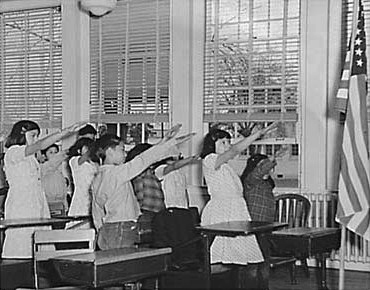
I Pledge Allegiance
I pledge allegiance to no flag nor the republic for which it stands. I recognize the tradition of sovereignty of the states making up that republic, and therefore, do not consider it to be indivisible. I reject the concept of the nation state being created, inspired, sanctioned or otherwise "under" a god. Leave me only the "liberty and justice for all" - that is all I believe in and all the allegiance we need.
Subscribe to:
Posts (Atom)
